
Listening for Tracks
Notes from the Cascadia Wild Wolverine Project
Words: Alistair Simmonds
When I first joined a winter tracking trip on Mount Hood, snow fell in slow, windless sheets and the forest smelled of cedar and woodsmoke. The mountain felt immense yet intimate, its ridges breathing cloud and silence. Around the fire that night, volunteers traded stories of what had crossed their camera traps or left faint traces in the drifts. Some were biologists, others teachers, musicians, or parents, all drawn by the same curiosity: who else shares this place with us, and how do we learn to notice them again?
As an Englishman living in Oregon, I am often awestruck by the natural beauty of this part of the United States. England’s green and pleasant lands offer no shortage of beauty, nor any lack of opportunities for long, convivial walks. Yet the British Isles meaningfully lack what is often called wilderness, especially when set beside some of the Earth’s last great wild places.
The Cascades form a volcanic spine shaped by watersheds and weather patterns, stretching from Northern California through British Columbia. Like all enduring relationships with land, a sense of belonging is shaped through attention and familiarity: the movements of a Pacific marten, the health of a salmon run, the return of wolves. To track animals here is to practice the grammar of belonging, a way of learning how a larger home holds together.
Through Cascadia Wild, a Portland-based nonprofit organization, I have found a way to express my respect for the natural world by helping educate people about the animals who live here and by supporting the Wolverine Tracking Project, a community science initiative that uses camera traps, tracking surveys, and scat analysis to map the lives of carnivores across Mt. Hood National Forest. The data gathered through these efforts is shared with Oregon’s Department of Fish and Wildlife and other researchers, helping to inform wildlife management decisions and the protection of rare carnivores. Much of that work begins with small acts of setup and waiting.
Among the tools of the Wolverine Tracking Project, none feel quite as emblematic as the camera trap. At first it appears to be a simple device: a small lens, a motion sensor, a means of recording animals that mostly move unseen. Yet there is a quiet humility in setting one and walking away. You leave it in the care of weather and time, trusting that the forest will decide what to reveal. Sometimes the camera records nothing more than falling snow or a bird pausing in the frame, small assurances that life continues. Other times it captures a single image that seems to hold an entire season of patience. The camera becomes a reminder that most lives here unfold beyond our schedules and beyond our sight, and that to witness even one frame of them is a kind of grace.
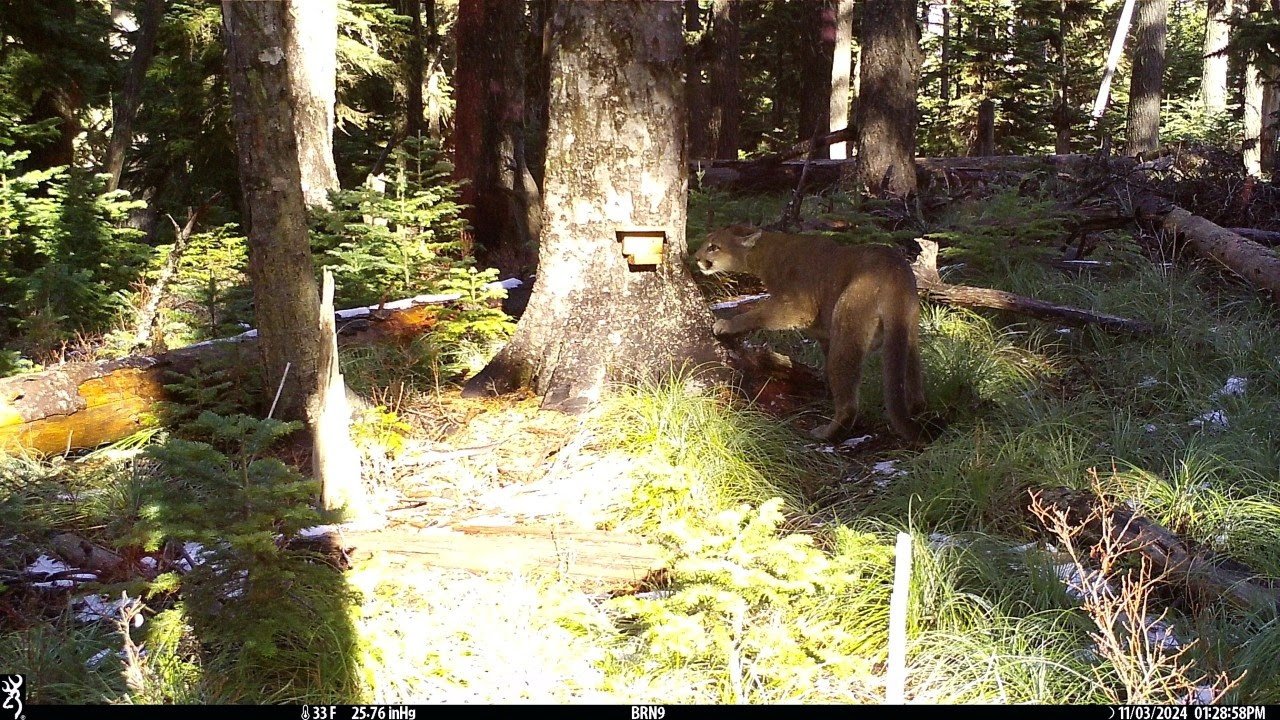
Mountain lion recorded by a remote camera in the Mt. Hood National Forest.
On clear mornings, away from the camera sites, the snow crust around Mt. Hood holds a stillness so complete that each paw print seems to sound. When volunteers pause over a set of signs, they are not only recording data but learning a dialect. The press of a marten’s paw, the drag of a fox’s tail, the softened rim where a heavier animal has stepped: each mark reads as a brief biography. To notice them is to remember that the forest is articulate in its own tongue, one most of us have forgotten how to hear.
Community science begins not with expertise but with attention, with ordinary people choosing to look closely and record what they see. In a time when much of our knowing arrives through screens, this kind of learning means kneeling in the mud, reading the ground, and trusting our senses again. Each volunteer becomes both student and witness, contributing to a shared record built slowly, through repetition and care. And sometimes, if you are lucky, that attention is rewarded: tracks in fresh snow, an image caught in passing, the sense of a life moving through just out of sight.
* * *
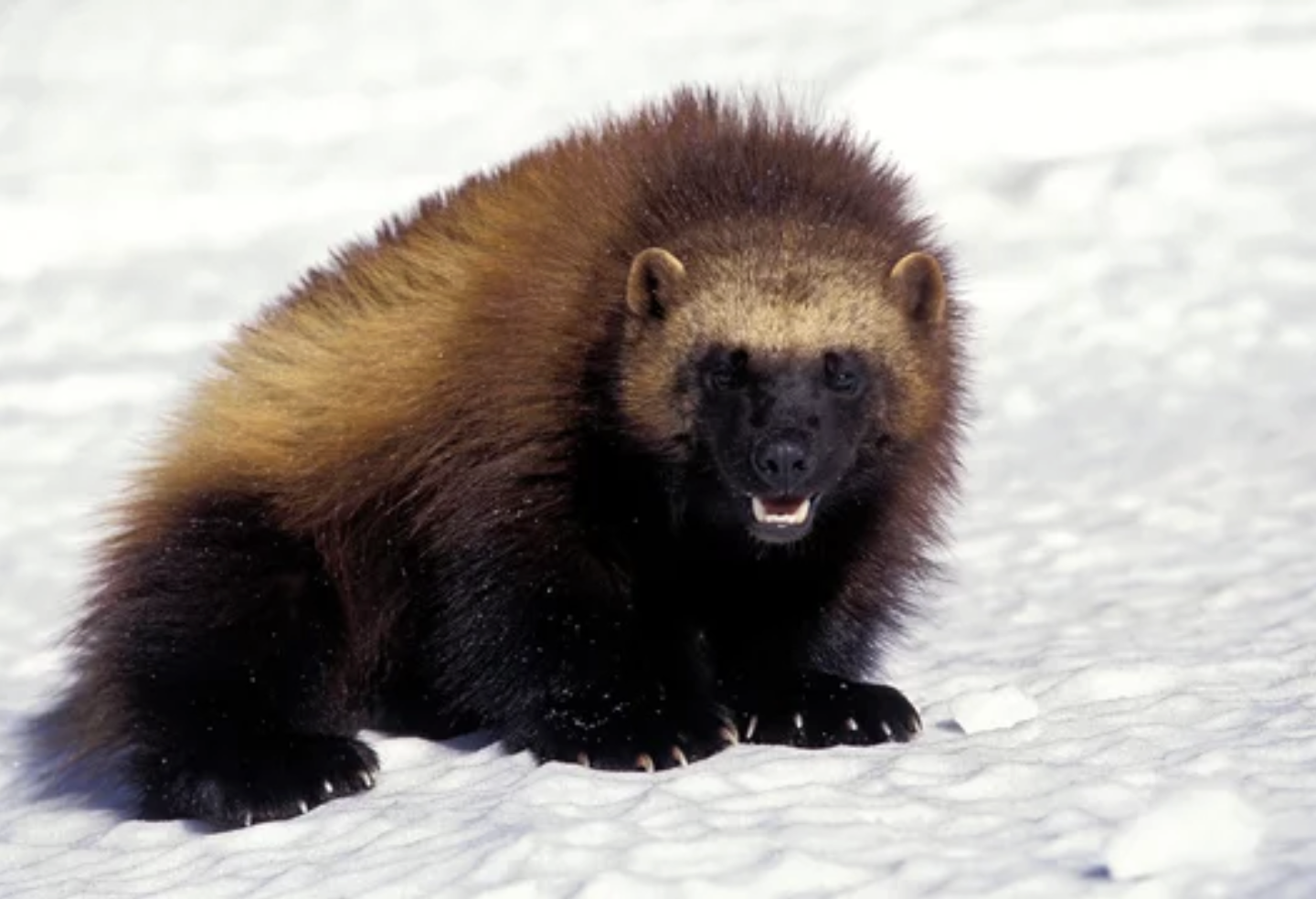
The most sought-after species, observed only and never trapped or disturbed, is the wolverine. It is the largest land-dwelling member of the weasel family, Mustelidae, and among its most formidable. In Oregon, its presence is more often inferred than seen, arriving as scattered evidence, or through images shared across a wider network.
The wolverine is especially vulnerable to climate change, in part because it depends on deep, persistent snowpack for denning. In The Wolverine Way, the writer and wildlife biologist Douglas Chadwick draws on five years of fieldwork in Glacier National Park to suggest that the wolverine functions much like a land-based polar bear, its survival closely tied to cold, snowy conditions.
Despite its modest size, seldom more than forty pounds, the wolverine carries the temperament of a myth. It has been called wilderness incarnate, a creature that seems to appear only where the world remains untamed enough to shelter it. Solitary and wide-ranging, a single wolverine may travel hundreds of square miles, crossing ridgelines and icefields with improbable endurance. Trappers once told stories of wolverines chewing through axe handles or stealing bait from sealed steel traps, accounts that drifted easily into folklore. Even today, their presence feels closer to rumor than record, a reminder that the wild can still exceed the reach of our instruments.
While wolverines have been documented across Oregon, including a series of sightings that traced one animal’s unexpected journey to the coast, Cascadia Wild’s work extends well beyond any single species. The project also gathers data on animals such as the Sierra Nevada red fox, gray wolf, and Pacific marten, alongside prey species like the snowshoe hare. Together, these observations form a broader picture of how lives move through this landscape, intersecting and diverging over time.
* * *
Each dataset, technical on the surface, is also a record of relationship, traces of how lives overlap and respond to one another. Reading these signs becomes a form of storytelling, where every set of prints suggests a rhythm, a hunger, a negotiation. In this way, the science quietly renews a practice older than science itself: paying attention until the landscape begins to speak back.
Every print, scat, and camera frame gathered on Mt. Hood becomes part of a growing map of life that extends far beyond this mountain. These same movements thread north toward the Olympics and Alaska, and south toward the redwoods and the Sierra. In following them, we are not only studying animals but tracing the pulse of a living coast, one that remembers itself through movement. To take part, even briefly, is to become a citizen of that larger landscape.
Projects like this do more than inform wildlife policy. They restore a habit of attention, a discipline of noticing that renews our sense of belonging to place. In an era when so much environmental news arrives as alarm, this quieter practice of walking, watching, and listening offers a counterweight. It reminds us that knowledge begins in wonder, and that care begins with knowing where we stand.
A Note on Cascadia
Cascadia is one name for a sense of regional continuity felt along the Pacific coast, from northern California into British Columbia. The region’s unofficial flag, known as Old Doug, was designed in 1995 by Alexander Baretich while living far from Oregon’s forests. Centered on a Douglas fir set against bands of blue and green, the flag offers a simple way of imagining place: forest, water, and sky held together beyond borders.
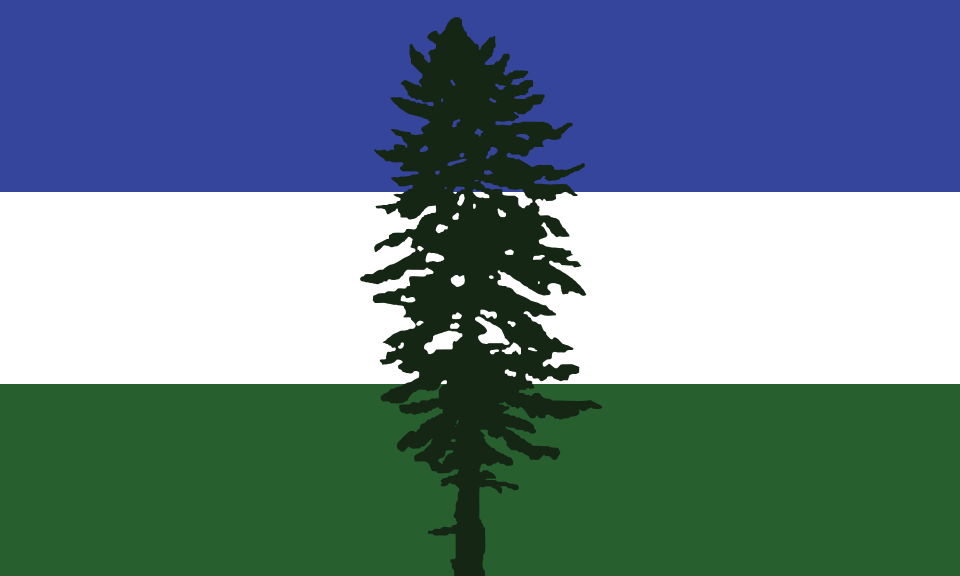
The Doug flag, a widely used unofficial emblem of the Cascadia bioregion designed in 1995 by Alexander Baretich.
—--
Alistair Simmonds is a Portland-based consultant working at the intersection of technology, strategy, and environmental impact. Originally from Chester, England, he has spent the past decade helping organizations navigate complexity and change. He is a volunteer trip leader with Cascadia Wild, a Portland-based nonprofit that coordinates the Wolverine Tracking Project in the Mt. Hood National Forest, where community members document the lives of carnivores through winter tracking, camera traps, and field surveys. When not working or in the field, he can often be found exploring the American West.